The Workflow
page described the guided loop in general. This
page shows what came out of it on one real project: Topological phase
transition in a symmetric blockade structure, a numerical study carried out
at the institute under the guided contract, in the einstein image, on the
institute’s compute cluster. The figures below are the figures of the
preprint, and every one of them was made by an agent; the words in
the paper were written by the physicists.
The project in plain terms
A quantum computer needs a memory that does not forget. One proposed way to build one is to arrange atoms so that the information is stored not in any single atom but in a pattern spread across all of them, where no local disturbance can reach it. The pattern in question is the toric code: a state in which the atoms’ excitations form closed loops on a honeycomb lattice. Every loop configuration counts equally, and the stored information sits in how the loops wind around the whole system. A state whose important properties depend only on such global winding, not on any local detail, is said to have topological order.
The ingredients are atoms that block each other from being excited when they are too close, a blockade. Arrangements of such atoms that produce a toric code had been proposed before, but without a proof: whether the state they produce really has topological order rested on numerics alone. Earlier work at the institute [1] changed that by building a particular symmetry into the arrangement. With that symmetry in place, it was proved that the ground state, the system’s lowest-energy state, is a toric code, provided the laser that drives the atoms is weak. A real experiment cannot drive weakly; the drive, written , is what makes the device do anything at all. So the question this project asked was: how strongly can you drive before the protected state breaks down, and what does the breakdown look like?
Answering that question is hard for reasons that have nothing to do with agents, and they shape everything below:
- The problem has no exact solution. The proof covers weak drive only. Beyond it, the only way to know what the ground state does is to compute it.
- It is a quantum many-body problem. Every site of the lattice carries several atoms, and the state of the whole system is a superposition over all their joint configurations. The number of configurations grows exponentially with the system’s size, so no computer can store the state of more than a few dozen sites exactly.
- The couplings are intricate. Which atoms block which depends on the direction of the link between their sites and on which of the four atoms on each site is excited. The pattern is what gives the model its local symmetry, and it is also what makes it awkward to implement.
- The interesting region is the most expensive one. Near a phase transition the parts of the system become correlated over long distances, and the compressed descriptions numerics rely on grow large exactly there.
- Numbers come from finite systems. Simulations run on cylinders a few cells around; the physics of the infinite plane has to be inferred from how results change with the circumference.
The method that makes the problem tractable is a tensor network, a compressed description of a quantum state that keeps only as much correlation as a parameter called the bond dimension, written , allows. The algorithm used throughout is iDMRG, short for infinite density matrix renormalization group: a method that improves a tensor-network state piece by piece until it is the ground state, and does so on an infinitely long cylinder by working on one small repeating unit at a time. It is implemented in the open-source library TeNPy [2]. Three more terms recur below. A phase is a range of parameters in which the system behaves in one qualitative way, and a phase transition is the boundary. The gap is the energy of the cheapest excitation above the ground state, the system’s lowest-energy state; a gap that closes to zero signals a transition. The toric code has two kinds of excitation, charges and fluxes, each with its own gap.
The model
The paper opens with the model, and so did the project. The physicists supplied the model files. They define the Hamiltonian, the operator that encodes all the energies: every coupling, the blockade pattern between neighbouring sites and the symmetry. The agent turned them into the conventions and the code the project then worked from. The first task in the plan asked it to summarise that model and the objectives in the draft; the publication task later asked for the figure at journal quality. The guidance for the whole paper stage set the division of labour in one sentence (the plan labels its tasks and rules F1, R3, P12 and so on, and uses terse physics shorthand):
The agent wrote the schematic as code in TikZ, a drawing language that is part of LaTeX, and went through several rounds with the physicists on what to show: the first version had the blockade edges of panel (b) in the figure below overlapping, a later round added a missing cluster and removed labels that said nothing. The figure as published:
 (enlarge)
The result of this stage is a model in which every ground-state configuration at zero drive is a loop configuration on the honeycomb lattice, and the local symmetry of panel (c) maps those configurations onto one another. The paper states that the proofs of the earlier work carry over, and then adds that none of them is relied on: every property is verified numerically below.
Building and validating the simulation
Before any production run, the simulation itself had to exist and be trusted. The second task asked for a TeNPy implementation with the model’s symmetries built in, tests against limiting cases, and estimates of what a run would cost. The plan left the numerical settings to the agent but named the constraint:
The agent built the model with its conserved charges, compared the full energy spectrum of a tiny system against an independent brute-force calculation, found and fixed a corrupted internal state that produced impossible measurement values, and ended with a validation suite of 28 passing tests. One decision in this stage came from the physicists and shaped every later result: which symmetries to impose. Imposing the symmetry along the cylinder would have mixed states that the measurements need to keep apart on some cylinder sizes, so the physicists kept only the symmetry around the cylinder. The geometry every simulation shares, and the two loop operators that read the phase off it:
 (enlarge)
The transition
The first production campaign scanned the drive at a fixed blockade strength, , where is the energy scale of the atoms' detuning, the offset of the laser frequency from the atoms’ resonance. The plan prescribed how a scan is run and when its result counts, and left the scheduling to the agent:
The agent ran chains of ground states in both directions across the transition, each point warm-started from its neighbour, for three cylinder circumferences, and escalated the bond dimension where the state would not converge: from through 512, 768 and 1024 to at the critical point of the widest cylinder, where a single point took thirty hours. The physicists steered at the decision points the log records: the escalation policy, which cylinders enter the fit for the topological entanglement entropy, and, at the figure stage, that the paper shows this one blockade strength with a two-by-two grid of panels. The four signatures from the scans:
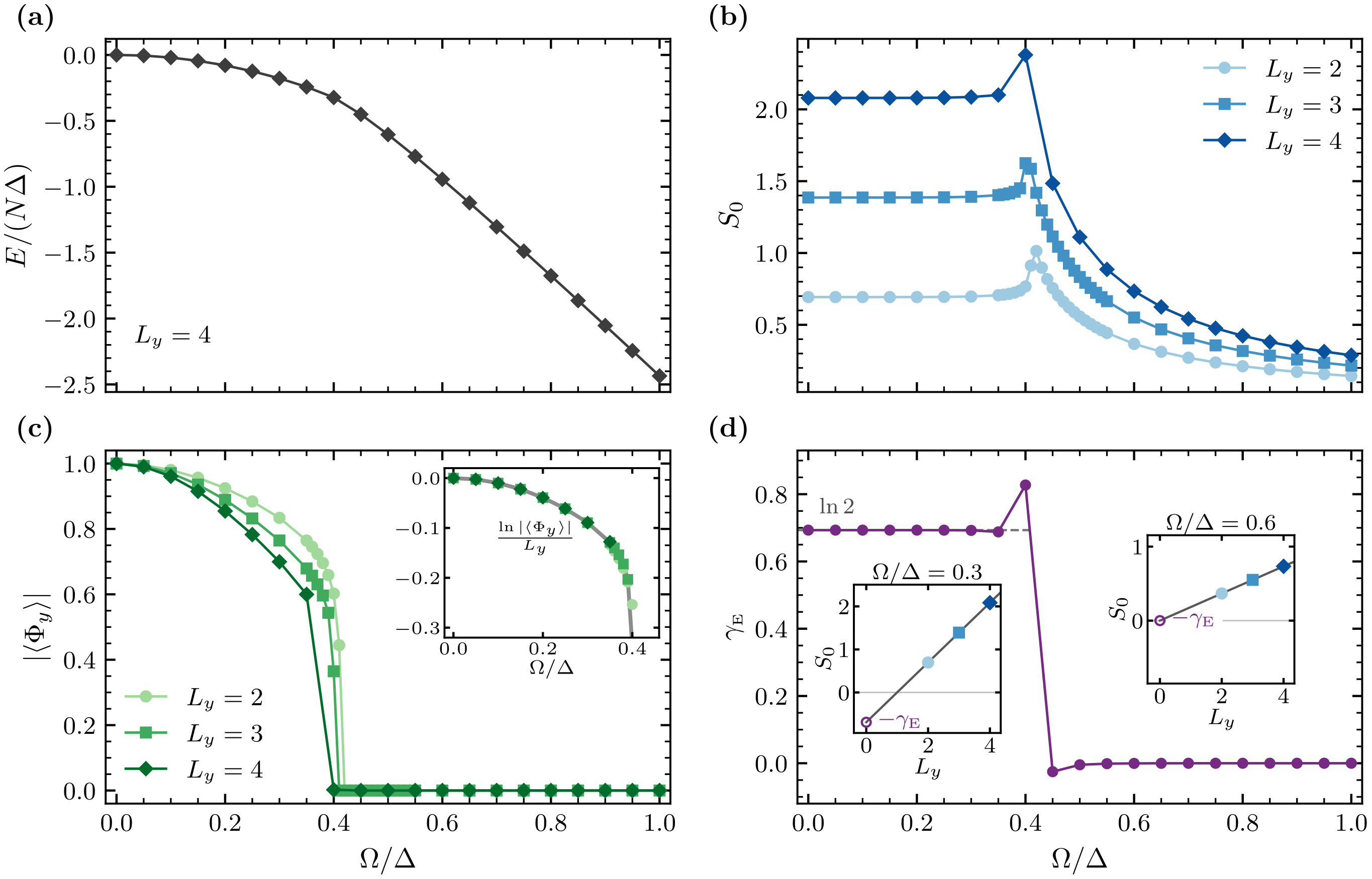 (enlarge)
The result is a single continuous transition at from a toric-code phase to a trivial one. Below it the entanglement entropy has the value the toric code predicts, the loop operator is finite, and the topological entanglement entropy, a number that is for a toric code and zero for a trivial state, is ; above it all three vanish. The energy is smooth through the transition and the same whichever way the drive is scanned, which is what a continuous transition looks like.
This campaign also sets the scale of the numerics. Every job ran on eight CPU cores of the institute cluster, and at the peak forty to fifty jobs ran at once, three to four hundred CPU cores across the cluster’s nodes. Summed from the run records, the ground states behind this figure cost about 2,800 CPU-hours; the whole campaign at this blockade strength, with the gap calculations of the next section and the runs that were cancelled or superseded along the way, about 25,000 to 30,000 CPU-hours. The agent submitted and watched all of it, requeued what timed out, and once traced a wave of failures to a partition of the cluster, a group of nodes with its own queue rules, that does not enforce memory limits. No human logged into the cluster at any point in the project, and no human wrote a line of code: every script, every job and every fix came from the agent, and the physicists read the lab book and the draft.
The two gaps
The paper’s central point is that the two kinds of excitation behave differently at the transition, and it took two separate campaigns and an analytic calculation to show it. For the gap in the symmetric sector, among excitations that share the ground state’s symmetry, the plan first asked for a method that reuses the stored ground states; when that method showed spurious boundary modes, the physicists sent it back to testing and the agent replaced it with TeNPy’s plane-wave method, which builds an excited state as a wave running over a re-optimised uniform ground state. For the charge gap the plan fixed the geometry and the check:
Numerics need something to be checked against, so the physicists also asked for the analytic behaviour of both gaps at weak and at strong drive. That is perturbation theory, an expansion in powers of the small quantity; for the charge gap at weak drive it has to be carried to twelfth order, because the gap first appears there. The agent wrote code that evaluates the expansion in exact fractions rather than floating-point numbers, so the prefactor came out as a fraction, , with no free parameter, and cross-checked it against the first numerical gap values the same day. Both gaps, with the analytic limits drawn in:
 (enlarge)
The result: the gap among the states that share the ground state’s symmetry closes at the transition, consistent with fluxes condensing, that is, proliferating in the ground state, while the charge gap stays open. Beyond the transition the charges are confined: pulling two apart costs energy proportional to the distance, like a string that cannot be broken. The numerics follow the twelfth-order prediction over five orders of magnitude. For a device this is the margin that matters: any real experiment breaks the local symmetry a little, and such perturbations act on the charges, so the protected phase should survive them as long as they stay below a gap that never closes.
The physicists’ steering shows in the log at every turn of this part: the decision to accept one point at the critical drive as approximate rather than escalate further, the instruction to keep the self-consistency error bars in the figure, the switch of panel (b) to a logarithmic scale because the linear one hid the power law. One line of inquiry was closed by hand: an attempt to extract the next correction to the charge gap from a small open patch of lattice gave values two hundred times the bulk value, and the physicist abandoned it as dominated by boundary effects. These gaps were the most expensive numbers in the paper. The excitation spectra behind panel (a) took five to ten hours on eight CPU cores per momentum point and about 12,000 CPU-hours in all; the charge-gap runs behind panel (b), each a pair of fifteen-hour simulations, about 5,000 CPU-hours.
How the charge gap is measured
The charge gap of the previous section comes from a construction the paper shows in a figure of its own, because nothing standard measures the energy of two charges on an infinite cylinder. The plan named the physics constraints; the method was the agent’s, proposed in writing and reviewed before it ran. The physicists caught one error in the drawing after the fact, by asking whether the charges sat where the data said they did, and the agent found the schematic off by one column and corrected it. The construction:
 (enlarge)
Three tricks make this work. The first is the window: the simulation on the infinite cylinder is not used directly. Instead a section four unit cells long is cut out of it, and the infinite ground state on either side is frozen into the window’s boundary conditions, so the section behaves as if it still sat inside the infinite system rather than at an edge. The second is the operator: a charge cannot be made alone, so a ribbon operator, a product of flips along a short line, is applied once. It creates a charge at each of its ends, two plaquettes apart. The third is the bookkeeping: an auxiliary term in the Hamiltonian, one that costs nothing in the ground state, is flipped on the two red plaquettes so that the simulation is pinned to the sector with the charges in it and cannot relax back. The two runs, with and without the charges, are then ordinary DMRG on the finite window with identical settings, not iDMRG any more, and their energy difference is the gap. Because the window is finite, the method needs a cylinder at least four cells around, which is why the plan fixed that size.
The full phase diagram
The last figure of the paper is the phase boundary over the whole plane of drive and blockade strength. Scanning it directly would have needed a fresh campaign for every blockade strength. Instead the physicists handed the agent a method from the literature, the reduced-basis surrogate [3]: compute the exact ground state at a few well-chosen points, then interpolate the whole plane from them with a built-in error estimate that says where the next exact point is needed. The plan set the diagnostic, the reuse of what existed, and the acceptance test:
The agent read the paper, wrote the mandatory literature entry, implemented the method for this model and validated it in tiers before proposing a production run. Two findings of its own shaped the method. The first came before any run: the reduced basis is built from overlaps between ground states, and for states on an infinite cylinder those overlaps vanish, an effect known as the orthogonality catastrophe. So the stored iDMRG states of the earlier campaigns could not enter the basis, iDMRG itself was no longer the right tool, and the agent switched to ordinary DMRG on finite cylinders, reusing the earlier campaigns only for the choice of sample points and as checks. The second came from the tests: on a finite open cylinder the usual loop operator is not an order parameter, and a correlator of two loops has to be used instead. The physicists steered the run itself: a finer training grid when the first was too coarse, an extension of the blockade range, and a second, methodologically clean run once it was clear that the first run had chosen its sample points under two different rules. The map, built one ground state at a time:
 (enlarge)
The result is the boundary of the toric-code phase across the plane from 80 exact ground states, checked against the independent scans at three blockade strengths and fitted in both limits by simple formulas the physicists derived. Compared with the campaigns above, this figure was cheap: the run shown cost a few hundred CPU-hours, and all reduced-basis runs together, with their validation, between 2,000 and 3,000 CPU-hours.
The paper
The manuscript is published as a preprint and under peer review:
The paper’s note on AI usage states the division of labour in two sentences; spelled out, the work that a doctoral student would usually have done fell to the agents, and the work of a supervisor and author stayed with the people:
What the agents did
- implemented the model in TeNPy and the validation suite
- ran every simulation on the cluster: scans, bond-dimension escalations, excitation spectra, charge-gap pairs, the reduced-basis runs
- derived the perturbation series, including the twelfth-order charge-gap prefactor, in exact arithmetic
- read the reduced-basis paper and implemented the method for this model
- drew every figure and schematic and kept them reproducible from the shipped data
- kept the lab book and the task and problem lists
What the physicists did
- posed the question and wrote the plan: the model, the parameters, the tasks, the acceptance rules
- decided at every turn: which symmetries to impose, when to escalate and when to accept, what to abandon, what the figures show
- verified the results independently, reviewed the code and performed the consistency checks
- wrote the text of the paper, every paragraph
- take responsibility for its content
What this project showed
This was the institute’s first productive use of agentic AI in research, and its lesson is plain. The work that a doctoral student would have done on this project, the implementation, the campaigns on the cluster, the analytic checks, the figures and the bookkeeping, was done by agents under written rules, to publication standard, with the physicists steering and verifying. That changes how science is done: a group’s output is no longer bounded by the number of its students, and the scarce resource becomes the judgement that sets the questions and checks the answers. It also sharpens the questions the overview left open. If the research contribution of a thesis can come from an agent, what is a thesis for? And who will be able to check the agents’ work in a few years? On this project the physicists could review the code and the results because they had spent years running such simulations themselves. Nobody acquires that expertise by reading an agent’s lab book. If the next generation never implements a model in TeNPy, never debugs a convergence problem, never derives a perturbation series by hand, the people who could tell a right answer from a plausible one will retire, and trust in results like these will have to rest on something other than human expertise. What that something is, nobody knows yet.
References
- Topological order in symmetric blockade structuresPRX Quantum 6, 030340 (2025) · doi:10.1103/dtlf-2q82 · arXiv:2503.17123
- Tensor network Python (TeNPy) version 1SciPost Phys. Codebases, 41 (2024) · doi:10.21468/SciPostPhysCodeb.41 · arXiv:2408.02010 · tenpy.readthedocs.io
- Reduced basis surrogates for quantum spin systems based on tensor networksPhys. Rev. E 108, 025306 (2023) · doi:10.1103/PhysRevE.108.025306 · arXiv:2304.13587